


The market for antique stoneware and ceramic jugs requires a discerning eye, as the line between a well-preserved original, a restored piece, and an outright forgery can be remarkably thin. For collectors and enthusiasts, understanding the physical characteristics of aged clay and glaze is essential. An authentic piece of antique stoneware carries the physical history of its use, firing, and survival over decades or centuries. Conversely, modern reproductions or heavily repaired items often exhibit telltale signs of artificial aging or hidden structural work that can significantly alter their historical value and desirability.
Distinguishing between honest age and manufactured distress is fundamental to evaluating any piece of historical ceramics. True wear patterns develop gradually and logically. For instance, the base of a jug will show friction wear from being pushed across wooden tables or stone floors. The handle may have a smoothed area where hands have repeatedly grasped it, and the pouring lip might display microscopic chips or glaze loss from contact with cups or other vessels. These marks of utility are random yet purposeful. In contrast, artificially aged items often display wear in illogical places, such as deep scratches in recessed areas that would rarely contact another surface, or uniform abrasions that suggest the use of sandpaper rather than the passage of time.
Honest Age Versus Manufactured Distress

Authentic patina is the result of years of handling, environmental exposure, and the slow accumulation of surface changes. On unglazed portions of stoneware, this manifests as a deep, ingrained darkening that cannot be easily scrubbed away. Forgers sometimes attempt to replicate this by rubbing dark stains, shoe polish, or even dirt mixed with glue into the porous clay. A close inspection, perhaps with a jeweler’s loupe, will often reveal that artificial patina sits on the surface or pools unnaturally in crevices, whereas genuine aging penetrates the clay body more uniformly.
Furthermore, the physical weight and resonance of the piece can offer clues. Antique stoneware was often heavily potted for durability in a working environment. While not an absolute rule, many modern fakes feel disproportionately light or heavy compared to verified examples. Tapping the rim gently with a fingernail or a wooden pencil can also provide information. A clear, ringing sound generally indicates a structurally sound piece, while a dull thud can suggest a hidden crack or an extensive structural repair that interrupts the acoustic properties of the fired clay.
Spotting Common Restoration Methods
Restoration in ceramics is not inherently negative; historically significant pieces are often conserved to prevent further deterioration. However, undisclosed repairs are problematic. Restorers frequently use modern epoxies, resins, and acrylic paints to fill chips, reattach handles, or rebuild entire sections of a vessel. While a highly skilled restorer can match the color and texture of the original glaze almost perfectly under normal room lighting, these modern materials react differently to various light sources and environmental factors.
- Examine the surface under a raking light, holding a strong flashlight at a sharp angle to highlight differences in surface texture.
- Look for areas where the surface reflectivity abruptly changes, as modern clear coats rarely match the exact sheen of antique salt or slip glazes.
- Check the interior of the vessel for drips of glue or mismatched clay color that the restorer may have neglected to finish.
- Feel the surface with your fingertips, as human touch is incredibly sensitive to slight changes in temperature and friction between original ceramic and resin fills.
Raking light is particularly effective because it casts long shadows over even the smallest surface irregularities. A repaired crack that has been filled and painted over may look seamless from straight on, but a raking light will often expose the slightly raised or flattened area where the filler meets the original glaze. Additionally, many modern overpaints and adhesives will fluoresce brightly under an ultraviolet or black light, revealing the exact extent of the restoration in a glowing, undeniable map of modern intervention.
Understanding Crazing and Glaze Pooling

Crazing refers to the fine network of cracks that can develop in the glaze layer over time. This happens when the glaze and the underlying clay body expand and contract at different rates due to temperature fluctuations or moisture absorption. Genuine crazing is a slow process, and over decades, dirt and organic matter settle into these microscopic fissures, darkening them and making the network visible. If a piece exhibits crazing that is stark white and clean, it may indicate a modern piece that was artificially crazed by rapid cooling after firing, a common technique to simulate age.
Glaze pooling occurs during the original firing process. When the kiln reaches its peak temperature, the glaze becomes fluid and tends to run downward, collecting in thicker pools around the base, under handles, or in decorative crevices. This pooling is a natural consequence of gravity and heat. In authentic antique stoneware, these pools will often have a depth of color and a specific crystalline structure. Fakes sometimes try to mimic this by applying thicker layers of colored slip in these areas before a low-temperature firing, but the result often looks painted on rather than naturally flowed.
Why Perfect Condition Raises Questions
While finding an antique piece in pristine condition is the dream of many collectors, true perfection in utilitarian objects like stoneware jugs should invoke a healthy degree of skepticism. These were working items, used daily in dairies, kitchens, and taverns. It is statistically improbable for a utilitarian object from the nineteenth century to have survived without a single flea-bite chip, a minor firing flaw, or a small scratch. If a piece appears entirely flawless, it requires the most rigorous examination.
A flawless appearance may indicate that the piece is a modern reproduction, or it could mean that the item has been comprehensively restored, with the entire surface airbrushed and sealed to hide extensive damage. Look closely at the edges, the rim, and the foot ring. These are the areas most vulnerable to impact. If they are impeccably smooth and perfectly uniform in color, consider whether the piece might have been ground down to remove chips and then re-glazed or painted to hide the alteration.
Recording Condition Before Transactions
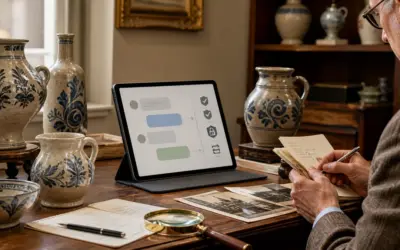
Whether you are acquiring a new piece for your collection or preparing to sell one, documenting its condition accurately is crucial for transparency and protecting your investment. Relying on memory or a few casual photographs is insufficient when dealing with valuable antiques where minor flaws significantly impact valuation. A systematic approach to condition reporting ensures that both buyer and seller have a clear understanding of the object’s state.
Create a standardized process for inspecting and recording. Photograph the item in natural daylight from all angles, ensuring the images are in sharp focus. Take extreme close-ups of any known damage, firing flaws, or suspected repairs. Write a detailed description that notes the exact location and dimensions of any chips, hairlines, or restoration work. If a piece has been examined under ultraviolet light or raking light, document those findings as well. This level of detail not only builds trust in a transaction but also provides a permanent record of the piece’s condition at a specific point in time.
Frequently Asked Questions
Can boiling water be used to test for modern restorations on stoneware?
While some older adhesives will soften or turn cloudy when exposed to very hot water or steam, this method is highly discouraged as it risks causing thermal shock and creating new cracks in the antique clay.
Do all types of antique stoneware glazes develop crazing eventually?
No, crazing depends heavily on the specific chemical composition of the glaze and the clay body, as well as the firing temperature; high-fired salt glazes, for example, rarely craze compared to lower-fired lead or alkaline glazes.
How can I safely clean a newly acquired antique jug without damaging the surface?
Begin with the gentlest method possible, using only a soft brush and distilled water, avoiding harsh detergents, bleach, or abrasive scrubbing pads that can strip away authentic patina or degrade fragile glazes.
Disclaimer: This article is intended as a general guide for educational purposes. Authenticating antiques requires significant expertise and hands-on experience. Buyers and sellers should consult with professional appraisers or reputable dealers before making significant financial decisions regarding historical ceramics.


0 Comments